




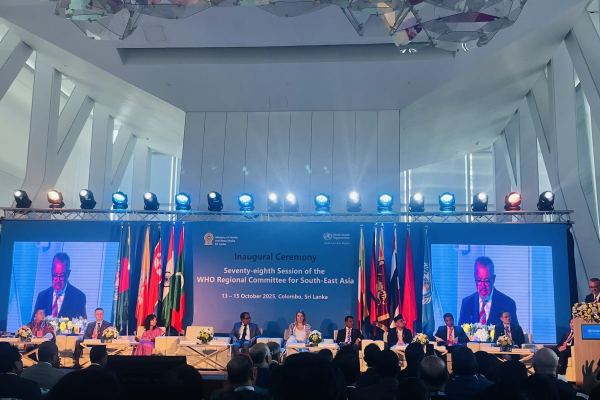
In a year shaped by the Fourth UN High-Level Meeting on Noncommunicable Diseases and Mental Health (HLM4), the 2025 WHO Regional Committee Meetings (RCMs), held from August to October, offered a crucial opportunity to carry global commitments into regional decision-making spaces. With most RCMs taking place in the weeks following the HLM4, attention quickly turned to what implementation would look like on the ground.
Supported by the NCD Alliance (NCDA), regional NCD alliances engaged governments, WHO regional offices, and partners to help sustain momentum, influence priority-setting and reinforce the central role of NCDs in achieving Health for All during this politically critical moment.
The 2025 RCM cycle: timing, presence, and follow-through
While the Regional Committee for Africa (AFRO) convened in August — just ahead of the HLM4 — all other WHO regions met in late September and October, creating an immediate opportunity to reflect the global commitments of the HLM4 within regional priorities.
NCDA supported regional alliances to engage at each meeting, ensuring a coordinated civil society voice at a pivotal moment for follow-up and implementation. Alliances delivered statements, tracked discussions, and engaged Member State delegations in both formal and informal spaces alike to position NCDs firmly within regional debates.
Representation included:
- AFRO: Africa NCDs Network (ANN); East Africa NCD Alliance (EANCDA) (Lusaka, Zambia)
- EMRO: Eastern Mediterranean NCD Alliance (EMR NCDA) (Cairo, Egypt)
- PAHO: Healthy America’s Coalition (CLAS); Healthy Caribbean Coalition (HCC) (Washington, D.C., USA)
- SEARO: South-East Asia NCD Alliance (SEAR NCDA) (Colombo, Sri Lanka)
- EURO: In the absence of a regional alliance, NCDA was represented by Jessica Amegee Quach, Senior Capacity Development Officer, NCDA (Copenhagen, Denmark)
Inside the room: integrated approaches as the way forward
With the HLM4 energy still creating a buzz, discussions touching on NCDs across this year’s RCMs reflected a clear shift in emphasis. Rather than revisiting why NCDs matter, attention moved to how commitments would be delivered — and where responsibility for follow-through would sit at regional and national levels.
At AFRO, the ANN reported a noticeable change in tone. NCDs were increasingly framed not as a future burden, but as an immediate socioeconomic challenge, with Member States pointing to strengthened primary health care (PHC), domestic financing, and workforce capacity as essential next steps for action.
“The level of engagement on NCD issues indicates that there is more traction on recognition, commitment, and desire to advance the NCD agenda by Member States in coming years.”
– Harriet Abeda Executive Director, NCD Alliance East Africa
Across regions, PHC repeatedly emerged as the main entry point for implementation. In Africa and South-East Asia, discussions centred on embedding NCD services within PHC and essential benefit packages. In the Americas and Europe, debates highlighted the limits of overstretched PHC systems, particularly where workforce shortages and fiscal constraints threaten continuity of care.
Emergencies and system resilience also featured prominently. In the Eastern Mediterranean, EMR NCDA highlighted growing recognition of the need to protect continuity of NCD care in fragile, conflict-affected, and humanitarian settings. In South-East Asia, civil society organisations (CSOs) similarly linked NCD action with emergency preparedness and climate resilience, reflecting increasing exposure to climate-related shocks.
“The sessions in the RCM demonstrated a renewed sense of solidarity among Member States in addressing emerging and persistent health challenges, particularly antimicrobial resistance, climate change, and health system preparedness.”
– Manita Pyakurel Secretary, South East Asia Region NCD Alliance
Taken together, the RCMs functioned as early stress tests for the post-HLM4 agenda — revealing where regional priorities are beginning to align with global commitments, and where sustained political attention will be needed to translate ambition into durable action.
Civil society where it mattered most
Across all regions, civil society engagement was visible, organised, and persistent. Regional alliances shaped formal statements, co-hosted official side events and worked consistently — often behind the scenes — to keep NCDs anchored in discussions on wider issues relating to health systems, workforce pressures, and policy coherence.
At AFRO, civil society itself became part of the advocacy agenda. Through their interventions and bilateral engagement, ANN and EANCDA used the RCM to call for more regular, structured ways of engaging civil society in follow-up to NCD commitments, underlining that meaningful implementation will require their role to be recognised and embedded — not ad hoc.
In the PAHO region, the conditions for engagement themselves became a live issue. HCC and CLAS highlighted that ensuring civil society could meaningfully follow proceedings and remain present in the room required deliberate coordination, preparation, and persistence—underscoring how easily space for civil society participation can narrow within formal proceedings.
At the same time, many discussions unfolded against a backdrop of financial constraints and heightened pressure on the multilateral system. Rather than sidelining NCDs, this context sharpened conversations around prioritisation and partnership. Several alliances noted that sustained civil society engagement was valued not only for advocacy, but for its role in supporting follow through, accountability, and implementation once the meetings ended.
“CSOs in the EMR are uniquely positioned to convene strategic dialogue with policymakers, and our RCM side event exemplified that leverage — elevating women’s cancer as a priority issue and catalysing the policy momentum the region urgently needs. Building on this influence, CSOs across the EMR are driving the broader NCD agenda by empowering patients, partnering with governments to expand access, advancing NCD integration into humanitarian settings, and shaping a more resilient regional health landscape.”
– Ibtihal Fadhil Chair, Eastern Mediterranean NCD Alliance
Taken together, the RCMs showed that civil society was not simply reacting to global momentum — it was helping to sustain it.
What the 2025 RCMs leave us with
The 2025 RCMs indicate that momentum from the HLM4 is carrying into regional spaces — but sustaining it will require deliberate follow through. Alignment around key priorities is taking hold; the challenge now is whether that alignment translates into decisions, delivery, and accountability.
As regional alliances shift into the next phase — tracking resolutions, supporting national advocacy, and pressing for accountability — the focus turns to how commitments are reflected in policies, plans, and budgets. The spotlight has not moved away from momentum, but squarely onto the work of implementation.
For civil society looking ahead, NCDA’s Pocket Guide: Turning HLM4 Commitments into Action offers practical guidance on sustaining momentum and supporting implementation at national and regional level.
The Alliances that are a part of the Advocacy Institute Regional Advocacy track are supported thanks to NCDA’s partnership with Bloomberg Philanthropies, Leona M. and Harry B. Helmsley Charitable Trust, and Novo Nordisk Foundation.