




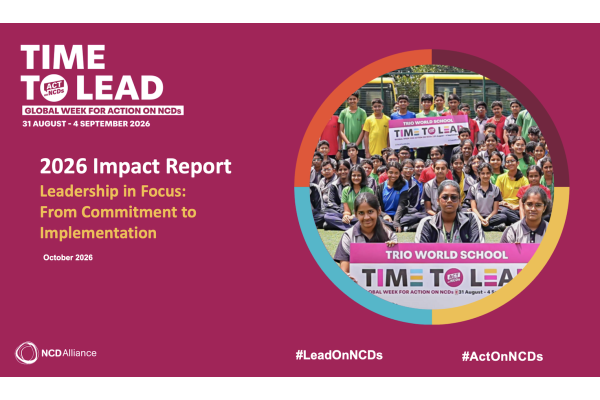
Across three years of Time to Lead, the NCD community recorded more than 880 events and activities worldwide and reached 18.8 million people on social media through #ActOnNCDs and #LeadOnNCDs.
The 2024-2026 Global Week for Action on NCDs Impact Report traces how members, people living with NCDs, supporters and the broader NCD network called on governments to act on NCDs and brought that call to life in their own countries and communities.
Run each year since 2018, the Global Week for Action on NCDs in one of the most visible and valued mobilisation efforts convened by the NCD Alliance in the global health space annually. It brings together civil society, national and regional NCD alliances and other members, and partners around a shared advocacy agenda.
Time to Lead began in 2024 as a three-year campaign leading towards the fourth UN High-Level Meeting on NCDs and Mental Health in 2025. It gave the global NCD movement a shared platform for calling on governments to demonstrate leadership through concrete action. In 2026, the campaign entered its third year with a focus on financing and accountability. How would governments fund their commitments, and what would progress look like for people living with NCDs?
Reflecting on this year’s Global Week, Katie Dain, CEO of the NCD Alliance, wrote:
“What made this year’s Global Week so powerful was not any single activity, voice or organisation, but the way each contribution strengthened the whole.”
The 2026 Global Week in action
More than 380 events and activities were recorded worldwide during the 2026 campaign alone. The week opened with a World Tour of videos from members and supporters, carrying voices and perspectives from across our global community. Between 1 July and 30 September, the campaign recorded 328,796 social media views and 14,008 interactions without paid advertising. Campaign videos attracted 85,352 views, with viewers watching for a total of 13,661 minutes.
National advocacy in Rwanda and India
Among the highlights was Rwanda’s first National Dialogue on NCDs. Convened on 4 September by the Rwanda NCD Alliance and Rwanda Biomedical Centre, the dialogue took place as Rwanda prepared its National NCD Strategy and Costed Action Plan for 2026–2030. Participants called for greater investment in affordable medicines, diagnostics and medical devices. People living with NCDs called for easier access to diagnosis, medicines and appropriate care.
In India, the Healthy India Alliance worked with HRIDAY and the Indian Institute of Public Health Hyderabad to examine barriers to NCD care in New Delhi and Hyderabad. Long waiting times, limited access to diagnostics and medicines, high out-of-pocket costs, language barriers and discrimination deepened these inequities. India’s interventions at the 2025 UN High-Level Meeting reflected several recommendations from the assessment, including equitable and empathetic care and recognition of lived experience as expertise.
Young people tell their stories through the NCD Diaries
Launched during the 2026 Global Week for Action, the seventh NCD Diaries series, Young Voices in Focus, puts young people’s experiences of living with NCDs at the centre of the conversation. Advocates used written, visual and podcast diaries to tell those stories in their own words.
Among them is Deanna Gracia from Indonesia, who lives with Graves’ disease. Through her visual diary, Deanna shared what it means to find connection with others living with a chronic condition.
“Living with a chronic disease as a young person is never easy, but I hope to raise awareness and support other young adults like me through these diary entries.”
New resources for advocates
During the Global Week, NCD Alliance launched From Commitment to Action, a policy brief setting out four financing priorities for governments. It complements the Advancing Access policy brief, which sets out global priorities for improving access to NCD medicines, diagnostics and medical devices.
The new Advancing Access advocacy toolkit helps advocates identify where barriers arise in their own countries and use evidence to press for specific changes. A companion case series on financing NCD medicines examines how Colombia, Uganda and Nepal are financing medicines through primary health care.
On the Road to Manila
The three-year Time to Lead campaign will conclude at the third International Dialogue on Sustainable Financing for NCDs and Mental Health in Manila on 16–18 February 2027.
During the 2026 Global Week, NCDA launched the NCD Financing Tracker to bring examples of government action together and make them more visible. Across four financing priorities, the Tracker documents how countries and regions are funding their NCD responses, where gaps remain and which approaches others could adapt.
Members and supporters can contribute examples from their countries and regions to inform discussions in Manila. After the Dialogue, the Tracker will continue to document how governments follow through on their financing commitments.
As Gina Sanchez, Campaign Coordinator, wrote in the report:
“The Road to Manila gives us another opportunity to build on what this community has created and press for concrete progress on sustainable financing for NCDs and mental health.”
Read the 2026 Global Week for Action on NCDs Impact Report

