




Noncommunicable diseases (NCDs), including mental health and neurological conditions, must be better integrated across the wider health agenda — from universal health coverage (UHC) and primary health care to sustainable financing and global health architecture reform.
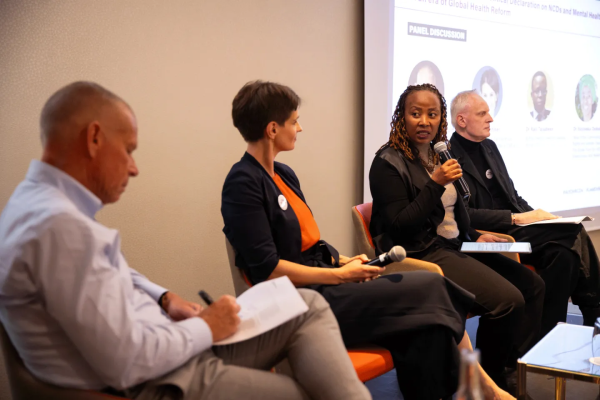
The event, Implementing the 2025 Political Declaration on NCDs and Mental Health in an era of Global Health Reform, brought together government representatives, WHO and experts in Geneva to explore how the 2025 Political Declaration can be implemented in a rapidly changing global health landscape.
Opening the event, NCD Alliance President Leslie Rae Ferat said the world is facing a pivotal moment, as cuts to global health financing and shifting geopolitics drive renewed debate about the future of global health architecture.
“This moment presents an opportunity to shape an agenda for global health reform that responds to today’s and future global health challenges,” she said.
Ferat said this is a chance to address the structural mismatch between global health architecture and financing, and the evolving health needs of populations, which are increasingly centred around NCDs.
New NCDA policy paper
Ahead of the event, NCD Alliance launched a new policy paper calling for NCDs to be meaningfully included in global health architecture reform.
It urges a shift toward integrated, people-centred health systems, national sovereignty, sustainable domestic resourcing, and formal engagement of civil society and people with lived experience.
Connecting NCDs with UHC and primary health care
Moderated by Dr Richard Horton, Editor of The Lancet, the discussion examined how the 2025 Political Declaration can support progress toward UHC and stronger primary health care.
“There’s an urgent need for hope and optimism to sustain us through the coming years,” said Horton.
Dr Teodoro Herbosa, Secretary of Health of the Philippines, said the third International Dialogue on Sustainable Financing for NCDs and Mental Health, taking place in Manila this September, must focus on implementation.
“The 2025 Political Declaration gave us ‘the what’. Manila must help define ‘the how’,” he said.
He added that political commitments alone are not enough, and that the September dialogue will focus on practical country support, strengthening domestic financing and building implementation capacity.
Mr Desmond Boateng, Chief Director, Ministry of Health, Ghana, said NCDs must be integrated into primary health care and national development agendas, including through wellness clinics and standardised protocols for hypertension and diabetes at sub-district level.
“NCDs are not just a health issue, they are a development imperative,” he said.
Dr Yosuke Kita, Director of the Global Health Strategy Division at Japan’s Ministry of Foreign Affairs, said Japan remains committed to advancing UHC as part of its global health leadership.
“Japan has consistently promoted UHC so that all people can access quality and effective health services without financial hardship,” he said.
Reimagining global health architecture for the NCD era
The panel then turned to how global health architecture can better reflect today’s epidemiological reality and disease burden.
Dr Anders Nordström, Senior Advisor on International Politics and Diplomacy for Health at Karolinska Institutet, said global health reform requires a fundamental shift in how the international system responds to disease burden.
“We should be looking at four paradigm shifts. The first is shifting towards NCDs to respond to the burden, the epidemiology; the other three are about looking forward, not looking back,” he said
Valerie Wehner, Head of Global Partnerships and Government Affairs EMEA at Vantive, said the private sector can support innovation and delivery when aligned with country priorities and health system needs.
“One part of the solution is to move care out from hospitals and into patients’ homes, providing integrated digital solutions into the patient care pathway,” she said. “The private sector plays the role of an enabler.”
Dr Vuyiseka Dubula, Head of the Community, Rights and Gender Department at the Global Fund, called for faster progress on integration and stronger community engagement in reform processes.
“The time has come to really accelerate integration, accelerate looking beyond silos,” she said.
She also warned that meaningful community engagement must remain central, particularly where civic space is restricted.
“We must also look at how communities are going to engage in that transformation, in that policy engagement, at country level when civil space is almost non-existent or closed,” she said.
Keeping NCDs visible in the next phase of reform
Closing the event, Dévora Kestel, Director of NCDs and Mental Health at WHO, looked ahead to key opportunities to advance integration and implementation, including the Manila Global Financing Dialogue, the UN High-Level Meeting (HLM) on HIV/AIDS, the 2027 HLM on UHC, and the WHO-led process on global health architecture reform.
“We are facing three fundamental shifts: from fragmentation to integration, from short-term projects to sustainable assistance, and from the health sector to whole-of-society engagement,” she said.
Kestel said global health architecture reform is an opportunity to place NCDs and mental health at the centre of future health systems, reflecting today’s disease burden and aligning financing, country priorities and integrated service delivery.
The event also briefly introduced NCD Alliance’s next phase of campaigning through the Global Week for Action, focused on moving from commitments to delivery.
As WHA79 continues, NCD Alliance is calling for governments and partners to ensure that NCDs and mental health are embedded across the global health agenda — from UHC and primary health care to financing and global health architecture reform.
Without this shift, reform risks failing to respond to the realities facing health systems, communities and people living with NCDs.